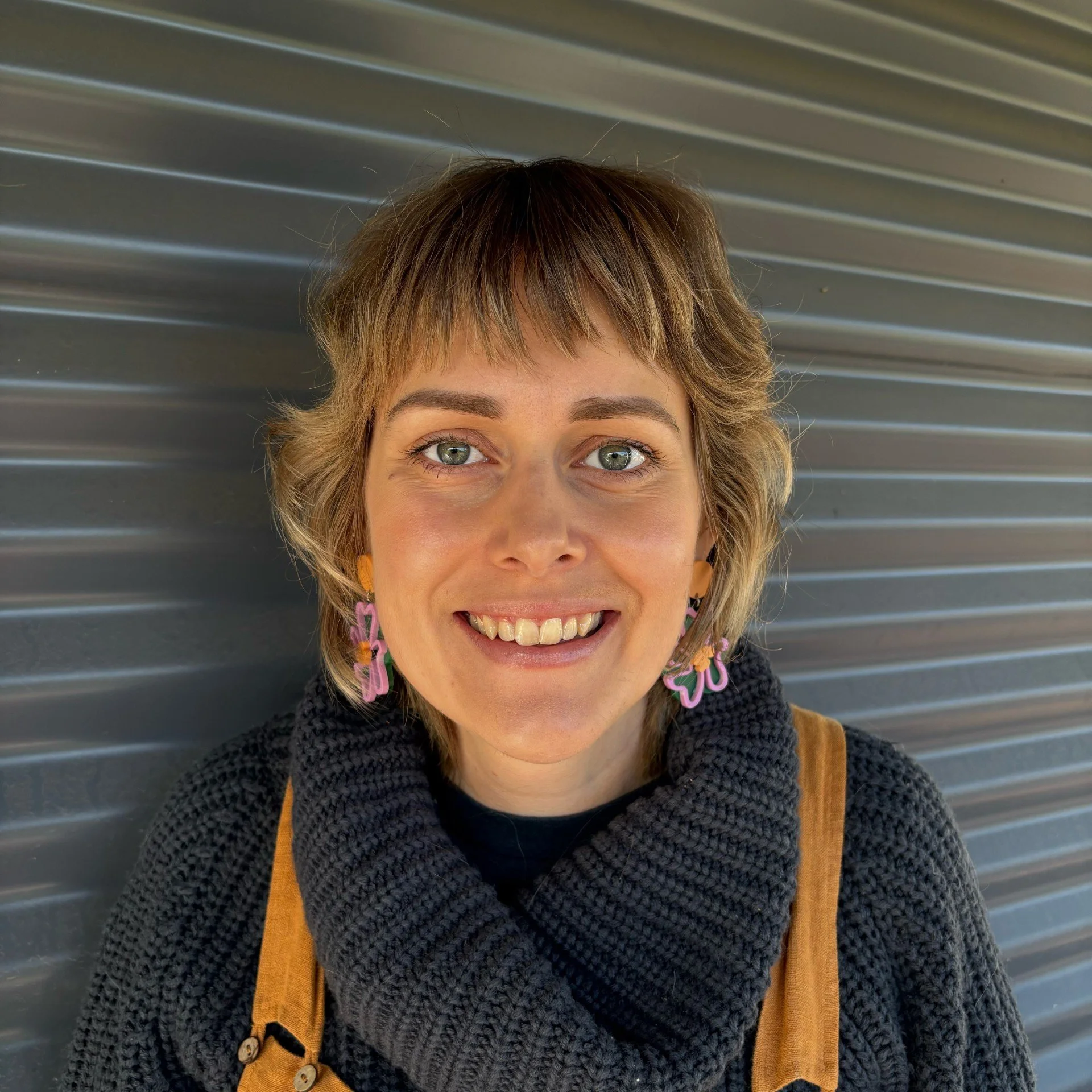
Meet Elizabeth Holmquest
IVF mother | Story and Myth lover | EMDR Therapist | Neuroscience Enthusiast
I’ve been in the labyrinth too…
I spent four years in the trenches of infertility.
Deep in those trenches, you would have found me crying into my sushi at a shopping centre food court, withdrawing from family gatherings because of my propensity for crying, screaming into the void, "WHY MEEEEEE?", being prescribed antidepressants, lying awake at 3am wondering if I’d ever feel like myself again and when I did sleep, I’d have nightmares about dying alone of hypothermia in the wilderness.
I was a trauma therapist who had no idea that what I was experiencing was traumatic.
It took me a long time to recognise that this wasn't simply an unfortunate set of circumstances I needed to endure. My mental health was suffering, and I needed support.
I remember telling a friend one day that I felt like I was lost in a labyrinth. I had no idea whether the next corner would bring me closer to the exit or lead me further into the darkness.
I've always been drawn to stories and mythology as ways of making sense of human experience, so the metaphor felt fitting.
But something shifted when I stopped focusing exclusively on finding the exit and began paying attention to the thread. The things that might help me find my way through, even when I couldn't see what lay ahead.
Around this time, I'd completed training in Eye Movement Desensitisation and Reprocessing (EMDR) therapy and began receiving EMDR myself.
It was a game changer.
For the first time, I felt more equipped to navigate the labyrinth than I had through talking about my experiences alone.
The days were still hard, but not as hard. My sleep was still shit, but I wasn't lying awake at 3 am with nothing but doom running through my head. My mood improved. I felt more grounded, more like myself, and better prepared for whatever came next.
I began to understand something important, both personally and professionally: sometimes understanding why we're distressed isn't enough to help us feel differently.
We can know that something isn't our fault, that we're doing everything we can, or that worrying won't change the outcome, and still feel overwhelmed by fear, grief or helplessness.
Sometimes we need more than insight. We need opportunities to process the experiences that have left us feeling unsafe, overwhelmed or stuck.
That's what EMDR offered me.
And it's a big part of why The Fertility Labyrinth exists today.
Not because I believe there's a way to make infertility painless, or because I can promise you an exit.
But because I know how much difference it can make to have something to hold onto while you're finding your way through.
What I've built.
The Fertility Labyrinth is a space where psychology, neuroscience and story meet.
A place where the complex experiences of infertility, grief and reproductive trauma are met with compassion and care.
Through individual EMDR therapy, we explore how difficult experiences can leave an imprint on the nervous system, shaping how we see ourselves, our bodies and the world around us.
Together, we work to process the moments that continue to feel painful, frightening or unresolved. Not to erase what happened, or to find a silver lining, but to help those experiences feel less overwhelming in the present.
Because healing doesn't mean forgetting what you've been through.
My hope is that, wherever you are in your own labyrinth, these sessions offer a thread to hold onto — a way to move through what you've experienced with a little more understanding, a little more compassion and a little less fear.
My Story
It’s April 2025 and I’m 33 years old and I feel like the loneliest person in the world. It’s morning and I’m lying on the couch looking out my window onto a grey autumn day and I am not ok. I am not a functioning human at this point. The final straw has broken my back and I don’t know how to fix what I’m feeling, where to turn to for help or if I even have the motivation to try.
Even though I am a therapist, for the first time in my life, I cannot pull myself out of this.
I am doing everything right. I am taking the supplements. I am doing fortnightly therapy sessions. There’s a book next to me about staying empowered through infertility and IVF. But I feel anything but empowered. I feel broken, consumed by grief, deeply alone and angry at the universe. This is not how the story was meant to go.
I was not meant to find out, eighteen months into trying to conceive, during exploratory surgery, that I had deep infiltrating endometriosis.
I was not meant to miraculously fall pregnant while on a holiday to Bali, a month before starting IVF, only to be lying in a dark room five weeks later staring at a screen while an obstetrician looked for a heartbeat that had been there 3 weeks prior but now was not.
I was not meant to hear family members announcing pregnancies a week after I had learned, during a second endometriosis surgery, that my tubes were blocked and there was no real prospect of conceiving naturally again.
I was not meant to start IVF and miraculously have an embryo transfer scheduled on the due date of the baby I miscarried, only to have it fail.
I was not meant to endure two unsuccessful embryo transfers.
I wish I could tell you that there was a turning point that morning. A quote I read. A meditation I listened to. A profound insight that changed everything.
There wasn't.
But something did happen.
I started naming for myself what no one else had. I started recognising the enormity of my experience.
This was grief. This was trauma. This was the shattering of assumptions I had carried about my body, my future, and how my life was supposed to unfold.
I realised I was lost.
That day, I accepted this truth:
Some people seem to get the fertility elevator. They step inside and arrive at parenthood. Others take the stairs. The journey is harder than expected, but the path still feels visible. And some, get a labyrinth.
No end in sight.
No map.
No reward for effort.
No guarantee that the next turn would bring them any closer to what they longed for.
And like anyone lost in a labyrinth, I did not need to be told to think positively or stay grateful. I needed a thread.
I needed ways to remain connected to myself when I no longer recognised my own life. I needed language for what I was experiencing. I needed permission to tell the truth about how hard this was. I needed spaces where I did not have to explain why I was grieving, why I was anxious, or why I could hold both hope and despair at the same time.
Most of all, I needed people willing to sit beside me and say, "This is hard. You're not crazy. And you do not have to walk through it alone."
I became obsessed with this idea of the fertility labyrinth and with the question of how to hold onto a thread when everything felt uncertain.
I turned to everything I knew as a therapist. I immersed myself in grief theory, EMDR, mindfulness, and meaning-making. I drew upon the very approaches I had spent years helping others use, not to fix myself or force myself to feel better, but to find ways of staying connected to myself as I walked through the labyrinth.
And somewhere along the way, I made myself a promise.
If I ever found my way through this, I would come back carrying a lantern.
I would create the kind of space I desperately needed. One that honoured the complexity of infertility and pregnancy loss, one grounded in both psychological understanding and lived experience, and one that helped people find a thread to hold onto when everything else felt uncertain.
That promise became The Fertility Labyrinth.
Qualifications and Accreditations
AASW Accredited Mental Health and Clinical Social Worker
Graduate Certificate in Forensic Behavioural Science (Swinburne University 2023)
Master of Social Work (University of the Sunshine Coast 2014)
Bachelor of Social Science (Psychology) (University of the Sunshine Coast 2012)